Showing posts with label review. Show all posts

Saturday, September 5, 2015

IMDb #110 Review: Like Stars on Earth (2007)

Source: Wikipedia
Remember the high-pressure Indian school system from 3 Idiots? Now apply that shark tank mentality to elementary school. And condense all three idiots into a bucktoothed dyslexic savant.

Frankly, he's a weird kid. Friendly to animals, precocious artist, a total space cadet. At school, he's the punching bag; at home, the doofus makes his conventionally successful older brother look good. Which infuriates their disciplinarian dad. He's convinced his young son is dumb and the problem is his attitude.

Never mind sports, the kid's too uncoordinated to put on a shirt without help. When school gets too hard, he plays hooky and seeks solace in his deranged cartoon imagination. Simple arithmetic becomes whimsical adventures about colliding planets. The parents send him to boarding school (to toughen him up), then special school (when he's too tough to let anything out).

Then he meets the teacher to change his life.

The substitute art teacher. Who shows up to the first day of class dressed as a rapping French elf clown. He shares life lessons in song while dancing on desks. And instantly obtains choreographic control over a conga line of twerking schoolchildren.

(I ... what ... you ... you got me, Bollywood. I expected "unconventional," and not a single word of the previous paragraph.)

So the *ahem* unconventional teacher pries the potential out of the repressed genius using the rainbow crowbar of LEARNING THROUGH FUN. Through his experience instructing mentally retarded children, he explains to parents and superintendents the symptoms of dyslexia.

As it turns out, "stars on earth" refers to children and their unwritten futures, not huge raging balls of gas that would obliterate the planet and possibly the solar system. All it takes is a stellar teacher to keep the gas-balls from collapsing prematurely, to release an impossibly gifted child who can then achieve a predictably uplifting ending.

Can we spare a teacher's undivided attention for each troubled child? Hell no. The pay isn't worth it. Which emphasizes the rarity of these exceptional cases. And the tragedy of how many latent geniuses remain undiscovered -- or worse, become engineers.

(For example, I could be a kazoo prodigy and never know it. You could have been a world-renowned pet masseuse. But here we are. Where did we go wrong.)

164 minutes.

Friday, September 4, 2015

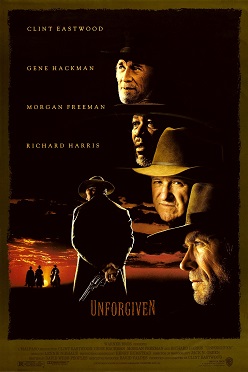
IMDb #111 Review: Unforgiven (1992)

Source: Wikipedia
The Wild West wasn't so wild to live in. It wasn't so much rugged loners taming a harsh land, as it was harsh land punishing the angry violent shitheads who couldn't survive anyplace else. And thus Clint Eastwood, old and charmingly crotchety, sets out to demolish the very myths he embodied in his youth.

For reasons unexplained by the introductory text scroll, a young lady marries a thief. He becomes a shitty farmer, until smallpox reduces his wife to a a mound of inanimate chemicals. Alone, he can't manage his hogs, let alone his motherless children.

Elsewhere in Wyoming, bad guys (who claim they aren't bad guys) rape and mutilate a prostitute. Without their pimp knowing, the ladies-of-the-night save up to put up a $1000 bounty on the bastards. This provokes the ire of the townsmen, who want to avoid the sort of ruffians attracted to the bounty on the other ruffians.

The prior category of ruffians include a crack-shot Englishman. He travels with his nebbish biographer and preaches monarchy to provincial dunderheads. Then the little town's petty sheriff (and shitty carpenter) kicks the shit out of the old man and provides the bland truth behind the embellished biography. This same sheriff strictly enforces the town's no-gun policy -- using guns, of course.

In the only predictable part of this anti-western, the farmer abandons retirement to hunt the bounty. He rides out with a young man who over-inflates his personal legend (whereas the old man downplays his).

It's an ugly, grungy story, grounded in reality and fertilized with pain. Guns make smoke; weapons fire and misfire. Men and women die slow and agonizing deaths, pathetically, sometimes in the outhouse. Riding out in the rain results in potentially fatal fevers. Self-styled heroes fight dirty, whereas braggarts run screaming at the first sign of danger. And killing messes people up for life -- "It takes all a man is, all he'll ever be." For both victim and perpetrator.

131 minutes.

Thursday, September 3, 2015

IMDb #112 Review: Scarface (1983)

Source: Wikipedia
A rough-edged tough-talking Cuban immigrant achieves the American dream -- fortunately, karma and law enforcement remind us it's a crock. Meanwhile, the titular antihero bends the world to his will, by the power of gravitational friendliness and gigantic adamantium balls.

This guy crawls up from the gutter -- shooting a Communist for a Green Card, scrubbing dishes in a roadside food stand -- to a key position in the coke trade. Mostly by accident. Also by a bloody negotiation breakdown which leaves several positions open.

He represents his boss to his boss's boss in Bolivia, speaking for the scary people with guns and money. He proposes marriage to the boss's girl at the man's own pool. It's incredible that his stomach hasn't swollen to galactic proportions with all the guts packed in there.

As usual for a career man, family relationships deteriorate like they're doused in acid. His mother refuses blood money; his sister wants to date men, but he's unreasonably protective of her and her afro.

The easiest way to turn a success story into a tragedy is to keep telling the story. Now at the top, he skis downhill off a mountain of cocaine into the canyon of deep shit.

Strangely enough, it's his uncompromising moral standards that ruin him. He wants the best for his kid sister, and kills to make sure of it. He won't hurt kids, and blows off the big boss to show it.

His personal gravity also makes him a bullet magnet.

This angry awkward Cuban and his weird cocky slur deserve their place in the movie museum of immortality. As does the final shootout in his villa, the last stand of a fascinating idiot who stuck to his guns till the guns stuck to him.

170 minutes.

Wednesday, September 2, 2015

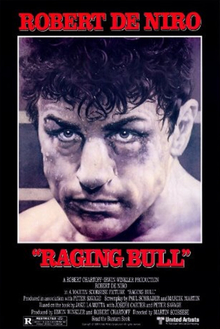
IMDb #113 Review: Raging Bull (1980)

Source: Wikipedia
A boxer's anger issues make and break his life. He blasts through the competition in the ring, but his outside life becomes so awful he wouldn't want to be anyplace else. A bull in a china shop, if broken crockery could sue for damages and file for divorce and hire thugs to pound his face to a pulp.

In the 1940s, while most young men are fighting in the world war, Jake LaMotta fights a war against the world -- and its pesky age-of-consent laws. He picks up a hot blonde teen at the public pool, treats her to a couple shitty dates, and despite his imperiousness and thick head manages to make it work. And withholds coitus to keep energy for fights. Nice going, champ.

Somehow he gets it into his thick head that his wife's cheating. He sure treats her like it. Then flips out when it becomes a self-fulfilling prophecy.

More importantly, he dominates the ring. He conks out opponents, despite small hands. His fast-talking brother manages his madness, though the beast on a short leash drags him places he would never go alone. The brothers share one big thing -- mistreatment of their wives. Them's the forties.

As much as the protagonist punishes everyone else, he punishes himself. Hard diet, hours in the sauna, slimming down to meet the bare maximum for middleweight. For one shot at the title. And if he wins? Sit around, watch TV, get fat. Until the collected rage breaks out and reduces his social life to Bikini Atoll.

Where am I going with this? Good question. Where is this going?

His fame goes nova, and he subsides into the white-dwarf shame of post-celebrity life. He opens a shitty nightclub. Becomes a cringeworthy stand-up comedian. And a jailbird, since it turns out acting on ephebophilia is still illegal.

Robert de Niro acts phenomenally, even when playing a character who's playing a bad actor. The best parts weren't even acting -- the physique, or subsequent lack thereof.

Then it just ends.

What's the point? I don't know. It'a a true story. The guy's still alive. You ask him. I'll...wait here.

129 minutes.

Tuesday, September 1, 2015

IMDb #114 Review: 3 Idiots (2009)

Source: Wikipedia
There must be serious problems with India's school system. Not only because of this movie's subject matter, but because of the little things it gets wrong.

First off, there are four main idiots, not three. And they're not really idiots, though they act like it. They're actually enrolled at a prestigious engineering college. Where the straitlaced superintendent remains convinced of their idiocy.

The possible exception among their gang is a cheerful laid-back genius. He flouts the rigid structure and advocates learning through fun (and song). His foil sneers at his laxity and crams his way to the top, bragging and flattering and forgetting everything he memorizes. The other two guys follow the first guy, because he's infinitely cooler. (Easy when you're rich and attractive and not just smart.)

No, it's not a school piece. Not entirely. The guys reunite ten years after graduation to find out who's most successful. Problem: the cool guy, name of Rancho, is missing. So his cronies (along with the weaselly brownnoser and his lethal flatulence) embark on a road trip to find him. It quickly skews into bizarre directions. While they flash back to the college misadventures that made them love him this much in the first place.

The main villain is the pressure to succeed. Fathers decide their sons will become engineers, never asking what their sons want to be. Wildlife photographer? Inventor? B-student? Dropout? Disowned. Brutally exemplified with a rash of student suicides.

There's an undercurrent of mischief -- the guys botch job interviews, sabotage stuffy speeches, crash weddings, threaten to drop a dead dad's ashes into a toilet, even foil a dignified suicide.

What could become unbearably gloomy or vacuously fluffy opts for the middle road: cheesy. There's singing (most notably "All Is Well," which works like a boppy poppy Engrish-saturated "Hakuna Matata"). Cartoonish sound effects accompany the contrived hijinks. And, another Bollywood staple, add the godawful CGI.

But I promise the weirdness leads to a point. The boozing, the romance, the rebellion -- it culminates in a climax as stirring as it is absurd. A bunch of male engineering students must midwife a baby during a power outage using only the miscellaneous tools at hand. How? I'm still not quite sure.

I've seen Bollywood formula work this way before. It softens the heart with warm sentimentality, then burrows in with rock-candy teeth and lays eggs.

171 minutes.

Monday, August 31, 2015

IMDb #115 Review: Up (2009)

Source: Wikipedia
The title of this Pixar adventure helpfully indicates in which direction it is misleading us. Not up, it's down. From America to South America, from soaring dreams to grounded reality, from breezy comedy to zephyrs of romance to doldrums of tragedy to the squalls of raging geezers clumsily dueling on a nosediving zeppelin.

A quiet nerdy boy meets a loud nerdy girl. They marry, grow old, endure tragedy along the way. Life eats their dreams and shits them out as lost time.

So the retired balloon salesman revenges himself on physics and society. He exacerbates the world helium shortage. He circumvents urban expansion and a pending lawsuit and the nursing home system by raising his decrepit technicolor homestead into the stratosphere. Using balloons. Many, many balloons.

Without proper steering or navigational equipment, the impossible flying house impossibly reaches its destination. The wild jungle of Paradise Falls, Venezuela.

Nothing can stop him now. Except a stowaway, a chubby Asian Boy-Scout-in-all-but-name (see: violently defended copyright).

The old grouch sends the kid on a snipe hunt. The kid returns with a hyper-intelligent chocolate-loving rainbow ostrich. Which the kid dubs Kevin.

In the untamed jungle of Venezuela, away from oil crises and drug wars and raging totalitarianism, there's a valley of weirdness. Realism need not apply. An elderly explorer can maintain a zeppelin large enough to house an airborne paleontology museum, staffed by talking dogs whose translation collars let them share their moronic thoughts with the world. This explorer guy has to be truly ancient; by now he's sunk so much time into his snipe hunt that he's not above cold-blooded murder.

Here we have Pixar at its silliest and downright darkest. It's presumably a realistic universe (despite, you know, balloons lifting a house and collars explicating canine minds), where the real magic happens in the animation and soundtrack and storytelling. The kids laugh; the adults fight back tears and hug their kids more often.

Anyway, the old man (the one with a cinderblock for a head, literally and figuratively) learns about the rigors of moving and moving on. The kid learns about the inherent risks of assisting the elderly. Sometimes you cross the street, sometimes another continent, and sometimes you're picking a dogfight with a flying fortress and a squadron of dogs in biplanes.

Like old age, happens to the best of us.

Sunday, August 30, 2015

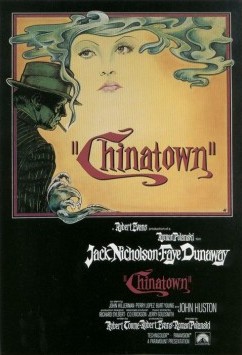
IMDb #116 Review: Chinatown

Source: Wikipedia
Film noir in color feels wrong for so many reasons. Not least of them is young Jack Nicholson.

Despite the title, of the story actually happens in Chinatown; most of it concerns the Los Angeles water supply in the Silver Age of the silver screen. Water, not Asians. In California, only one of these runs in short supply.

Even then, detective work sucked. But the typical detective personality makes hard work harder. He's a cynical, morally murky, antagonistic mercenary. The perpetual poverty intrinsic to the vocation doesn't help.

When work dries up like water in the desert sun, the alleged hero resorts to dirty jobs. He secretly photographs adulterers and distributes those incriminating Polaroids and accidentally detonates marriages. Amid the sleazy paparazzi moonlighting, he strikes a gusher: the water wars.

Digging around, he unearths weird shit. Disappearing water, dead people, and forged land records signed by long-dead people. As payment for services rendered, he receives a tax-free helping of trouble. A slit nostril keeps his smug mug in bandages for a predominant portion of the film.

Apparently moving water around is serious business. Divert it from farmland, dump it in the ocean,  and people freak out and start cutting up noses.

To keep the detective on edge, he bumps into the requisite femme fatale. The daughter of a wealthy water mogul (which exist -- California), she has more issues than a water tower made of mosquito netting. Her typical L.A. marriage problems, like infidelity and murder, escalate into kidnapping and even more murder and the police doing as little as possible about it. Which makes more room to work for our anarchic detective.

The consensual underage incest subplot becomes skeevier in retrospect considering director Roman Polanski's later scandals. And the infuriating ending only makes it worse.

What's there to do when you witness something horrible that there's nothing you can do about? Forget it, it's Chinatown.

131 minutes.

Saturday, August 29, 2015

IMDb #117 Review: Downfall (2004)

Source: Wikipedia
More Nazis? If movies even somewhat capture reality, then the Second World War was the most happening place in the history of the universe.

But this time the tables are turned. Then overturned, then burned to smoldering embers. This take on European Armageddon reflects a radical perspective -- the fall of the Third Reich, as seen from inside Berlin. Directed by legitimate Germans. With narration by the lady who was actually there in the bunker with Uncle Adolf. Hardcore history.

Back in the day, when she was young and naive and typed as well as Stormtroopers shoot, she was Hitler's secretary. The dictator dictates, the transcriber transcribes. Early on, when the war went well, he proves remarkably forgiving of the new girl's abundant typos.

In the last days, as Berlin cracks in the vise-grip of the Russian war machine, the Aryan Antichrist displays less composure. He's angry, stubborn, and worst of all, stupid. He shouts that his generals have betrayed him, and thus ignores their good ideas to stick to his own delusional tactics. His closest advisers fear to contradict his anti-logic.

These represent one of three camps on the Nazi sinking ship. The high-ranking officers who grimly remain at their posts, even as their pant legs grow worryingly soggy. More exciting are the party animals who throw frenzied orgies as the buildings shake and the electricity stutters. Less fascinating but more practical, the sane remnant who don life preservers and hop off the boat -- they risk being shot as traitors by their own people as well as the rising Soviet wave.

A handful of stories run parallel and intertwine. In the bunker, the secretary watches her national hero melt down like Chernobyl and feels the fallout poisoning everybody int he vicinity. Elsewhere, a father struggles to reclaim his suicidally patriotic son from the Hitler Youth. A doctor wants to leave but remains behind to aid the wounded, even though he's not a medical doctor, even though his job entails sawing off limbs without such luxuries as anesthetic.

Eventually even the truest believers realize all is lost. The Reich's most elite suicide club follows through with their black pact. The saddest case? The Goebbels family -- the perfect doe-eyed Aryan children sing to the disconsolate Fuhrer. At their doting mother's insistence, they pass around a cup of "medicine" like the worst Communion ever.

The mood of palpable desperation melts into raw despair. The combat is anything but glorious -- loud, messy, ugly as sin. And when the designated good guys win, the "where are they now" credits hit like a shower of icewater. And the thralls of history's monsters look disturbingly human.

178 minutes.

Friday, August 28, 2015

IMDb #118 Review: The Great Escape (1963)

Source: Wikipedia
A bunch of guys dig out of a German POW camp, or they do what they can before the Angel of Murphy strikes and the whole operation goes FUBAR. Movie notwithstanding, I fail to see what's so great about it.

Probably the cast. An impressive array of strong-jawed leading men who are wrinkly or dust by now. Or the criminally catchy theme tune which elevated these dusty supermen to celluloid immortality.

A parallel to the casting calls, all of the English-speaking escape experts are packed into one camp. Which is as "inescapable" as those in the other movies of its ilk. Germany is asking for trouble here. "All the rotten eggs in one basket" doesn't make for clever war strategy, unless you mean the second-worst Easter surprise ever.

Unlike the outside world, everybody inside has a job. Diggers, forgers, carpenters, structural engineers, tailors, moonshiners, and ... gardeners? Christmas carolers? For cover, obviously. Good thing the story skips the majority of the mind-crushing monotony, such as the countless hours Steve McQueen spends in solitary confinement not growing facial hair.

The plan? Liberate 250 men. The reality? Well, for a visual demonstration, toss a dirt clod into an oscillating fan. The few survivors scatter across occupied territory (and what lovely occupied territory -- you almost forget it's ruled by Nazis, or worse, the French).

They borrow or hijack bikes, boats, trains, planes. The French Resistance attempts to assist any who catch on to their act. But English idiomatic politeness threatens to undo them all. Rather anticlimactic.

The title didn't lie. The escape plan was pretty great. The greatest part of the execution is that anything worked out at all. (And the execution of the recaptured escapees, now, that's why they left in the first place.)

Thursday, August 27, 2015

IMDb #119 Review: Die Hard (1988)

Source: Wikipedia
A New York City cop can't relax on vacation. Visiting California to visit his estranged wife, he discovers the quintessential action movie, the best Christmas movie ever made, and only the third-worst Christmas of his life. Recognizing a wife's independent career in the eighties must have had these kinds of consequences.

The lone cop liberates an office building under siege by angry foreigners with machine guns. Barefoot, armored only in underwear, armed with only his wits and service pistol and metric fucktons of luck.

Ultimate testosterone fantasy: achieved.

But the bad guys aren't cardboard cutouts. Little details humanize them. They love their brothers, want money, appreciate culture, and might even seem charming before they blast your head off.

Despite petty motivations, the villain is crazy sophisticated. He reads Forbes and Time magazine. He does his own dirty work. He fakes a convincing American accent. That's right -- a Brit impersonating a German impersonating an American. It's ear-boggling.

The American Übermensch isn't alone in his struggle. He has the aid of the overly enthusiastic limo driver in the parking garage. And an overweight LAPD officer who acts on the distress calls and escalates the hostage situation to a national incident, which means bigger explosions and more guns and more fun for everyone.

The pacing is pitch-perfect, the plot tighter than the wife-beater plastered to Bruce Willis's rippling torso. It's wonderfully satisfying to watch, also like the wife-beater plastered to Bruce Willis's rippling torso. The recurring riffs on "Ode to Joy" become quite appropriate.

A word on the sequels.

Once is excusable. More than once becomes absurd. Repeatedly flouting plausibility strains the suspension of disbelief -- simple story engineering, with fake math to back it up. What the sequels miss is the humanity. Just some dude who doesn't know what he's doing and gets lucky. Not invincible supercop versus the entirety of Communist Russia. Just a sweaty nobody crawling in vents and elevator shafts and leaping off exploding buildings with a firehose for a bungee cord.

Never mind, they were always stupid. But the first one did it best.

132 minutes.

Wednesday, August 26, 2015

IMDb #120 Review: The Hunt (2012)

Source: Wikipedia
Pedophilia is a touchy subject.

Joking aside, this scenario is my nightmare. A forty-something single man working in a day care (already an awful idea) gets accused of abusing a kid in his day care. With his man-parts. And everybody believes the confused little person whose brain hasn't even fully developed yet.

Recipe for a ruined life. Combine a precocious kindergarten girl; her porn-crazed older brother; poorly phrased comments to the worst person imaginable, a paranoid old lady; and a provincial community of inflammatory idiots. At least the other kids have the excuse of being young and dumb when they hop aboard the hunt-the-pedo bandwagon.

He loses his job. His girlfriend. Visitation rights to his young son. Friends and family shun him. the community ostracizes him, the the point where he can't shop at the grocery store without risk of bodily assault. He can't replace the windows fast enough before more rocks crash through. And anybody who dares sympathize with the (alleged!) pervert suffer the same fate.

Most horrifying is the sheer plausibility, crystallized by convincing delivery from a talented cast. (Mads Mikkelsen is a madman.) Just watching fake things happen makes you irrationally furious.

Soon the little girl who inadvertently kicked off this madness can't dissuade the modern mob from their kangaroo-court vigilante justice.

And this shit goes on for a long time. Up till the saddest Christmas mass ever, when the outcast mere attendance makes a scene. (Then his impassioned plea for sanity makes the scene.)

The man's last shot at redemption is, pardon the poor taste in word choice, touching.

This kind of thing would never happen in America. They'd immediately boil him alive in a tub of HIV-positive hobo splooge. Which they keep on hand at all times for delicate cases such as this.

115 minutes.

Tuesday, August 25, 2015

IMDb #121 Review: On the Waterfront (1954)

Source: Wikipedia
At the docks, the mobs control who works and who starves, who gets paid off and what cash mysteriously disappears, what stuff gets shipped out and what goods remain suspiciously undeclared. Most importantly, they decide who meets unfortunate accidents for even thinking about breaking the code of silence.

Despite the name, stool pigeons don't fly very well. More stool than pigeon, when dropped off a building they go splat in the street.

Who's gonna care about a dead squealer? Not his friends, not his boss, not even his landlady. No, leave it to his angry little sister. Short on know-how but big on why-I'm-going-to, she vows justice.

She conscripts the help of a Catholic priest, who leaves his cloister to visit the flock at work. This is the type of guy who administers last rites to a guy who just suffered a not-so-mysterious accident right in front of him.

The priest calls special meetings in the church basement. Not for any suspicious reasons, but to implore the longshoremen to consider telling the truth instead of saving their own skins.

Our ostensible hero, Marlon Brando, starts out attending the meetings as a snitch. (See, guys, it's OK when we do it.) Then his dead buddy's sister gets under his skin, the skin he worked so hard to save.

"Johnny Friendly," the mob boss who's anything but, tightens his grip. He tosses the tosser into a crap job in the ship's hold. He tells the hero to lose the girl; the hero tells him to get lost. Which doesn't go over too well.

Then the crucial trial comes up, and what do you think happens. The good guy does the right thing and suffers for it. He's blackballed. His buddy's prize pigeons get their necks wrung -- more than mildly symbolic. Work dries up, as do his friendships. I won't say what pushes him over the edge, only that it leaves him no excuse not to fight back.

The ex-fighter gets back up. He's not D&D, deaf and dumb, like the other guys. He won't throw the second-most important fight of his life. And for all the time it takes to reach the peak, his "fight the power" moment is immensely satisfying.

I guess solidarity can be a bad thing. People are tough to change. Lots of people working together for the wrong reason are tougher. And any brave idiot willing to do the inglorious snitching for a good cause deserves a black-eyed patron saint in Marlon Brando.

108 minutes.

Monday, August 24, 2015

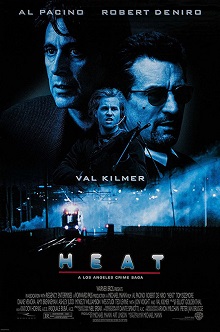
IMDb #122 Review: Heat (1995)

Source: Wikipedia
Al Pacino as a depressed workaholic LAPD detective? Robert de Niro as an emotionally detached safecracker saving up to leave his life of crime? And there's a passive-aggressive man-date scene where they sip coffee and snipe at each other? WHERE DO I SIGN UP.

This glorious collaboration begins with an armored truck robbery, which sets in motion all the horrible things to follow.

Meet the crime team as they make off with a motherlode of bearer bonds. A paranoid millionaire wants them back; the thieves don't want blood. They want to settle down with their wives and children. Well, except for one lonely bastard without love or a lover, and the maniac who just wants to steal things and kill people.

Heat has nothing to do with molecular excitation. It refers to the lonely bastard's motto: "Allow nothing in your  life you can't walk out on in thirty seconds flat, if you spot the heat around the corner." In essence, when the going gets tough, drop everything and ditch your buddies.

At the worst possible time, he falls for a bookworm/graphic designer girl. She might just pull him out of the crime world, if he weren't such a greedy vindictive asshole. If he weren't bringing the team back together for one last big job. Even if the heat has cranked up and the law is closing in on them.

Meet the detective. He tracks the team on scant evidence and recovers from embarrassing losses to their superior instincts. For a while.

But while the men play cat and mouse, their significant women and children suffer in isolated ignorance. Spouses squabble. Yes, the movie may be well-made, but the protracted arguments grow unpleasant quite quickly.

Until the bank robbery. Which devolves into the single best shootout I've ever seen in any movie. Mad props to the sound designer who made gunshots echo off streets and skyscrapers. Anyway, this amazing scene puts in in motion the other horrible things to follow. The giant scissors of justice snip the knotted plot threads without mercy or compassion.

It goes to show, real-life high-stakes games of cops-and-robbers only destroy the lives of everybody involved. So when the deuteragonists finally square off, knowing that innocent loved ones suffer no matter who wins, it's not a performance you can just walk away from with no lingering attachments.

170 minutes.

Sunday, August 23, 2015

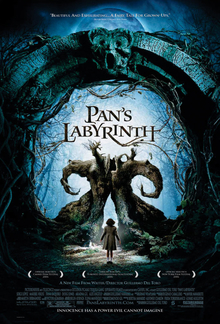
IMDb #123 Review: Pan's Labyrinth (2006)

Source: Wikipedia
Because this movie keeps insisting (and demonstrating) that life is nothing like fairy tales, it paradoxically becomes the perfect fairy tale. Not "magical realism," the paper umbrella that literary types slink under to duck the shitstorm associated with genre fiction. Not that. Fantasy, real fantasy. Because everything about this movie is fantastic. Even the icky parts.

The backdrop is rural Spain, 1944, in the midst of civil war. The players are archetypes from fairy tales.

First, the most despicable stepfather in fiction. This brutal soldier shoots first and asks no questions because he knows all the answers and accepts no substitutes. The sickly stepmother, battered and pregnant, supports the strong husband who has done so much for her -- and to her.

Our heroine is the fey and lonely little girl who stumbles into a hidden world of magic. A world where she's a lost princess, where a creepy faun living in a stone maze gives her three vague tasks to complete before the full moon.

Like director Guillermo del Toro's obsession with monsters, there is strange beauty in ugliness. Brutal violence, torture, abuse, pregnancy? Crawling in mud, choking on blood? Facts of life, depicted in agonizing detail. Just because a movie features a child protagonist does not mean the movie is for children.

Amid the horror, both real and supernatural, beauty lurks. The music, the story, the acting, the effects (which have aged surprisingly well), and did I mention the music? Sublime. Rather than contradict, the beauty amplifies the horror, the horror the beauty.

I won't spoil any more than that.

But, by way of conversation, I have to ask. Does the magic only happen in the girl's head? You could interpret it that way. If you're a miserable bastard with a cynical streak as broad as the Mid-Atlantic Ridge. Different perspectives make for richer repeated viewings, which I humbly recommend.

You could mine this movie for symbolism till civilization collapses and the Underground Kingdom rises up to reclaim the planet from irradiated cockroaches.

119 minutes.

Saturday, August 22, 2015

IMDb #124 Review: Mr. Smith Goes to Washington (1936)

Source: Wikipedia
Washington politics ain't no party. Especially not for a naive nobody from a conveniently unspecified state of the union. He's appointed senator because his simplicity makes him easy to manipulate. Along with being boring and incomprehensible, politics are actively malicious. Like if a Cat's Cradle string sprouted fangs and bit off your hands.

And what dirty things people do for a position whose authority equates to the power of a peep in a cyclone.

When a senatorial office opens up, a crooked politician's son suggests Mr. Jefferson Smith, a Boy-Scout-in-all-but-name (because that name's copyright is violently defended). Thus the squeaky-clean simpleton hops blindfolded aboard the crazy train to the roiling cesspool of government.

His legitimate patriotism worries people. He visits the major and monuments. Takes pictures. And actually seems to like people. The horror.

But rather than financial crises or national employment or foreign policy with the Third Reich, our hero deems the most important issue facing Congress to be his own bill: building a boy's camp in his unspecified state. On land which his fellow senators plan to raze to build a dam, because creating jobs by dubious means is apparently still evil.

Kids love him. Congress doesn't -- they think he's a bumpkin wasting their time, and they're not wrong. (Example: he sends letters to his mother by carrier pigeon.) The press loves to hate him, to twist his honest gaffes into national news. But this same sincerity affects his jaded secretary. Her support changes from compulsory to genuine, and her newfound high-pressure passion threatens to blow the lid off the whole crooked land-grab operation.

Perhaps most famously, and the crux of the story, is Mr. Smith's last ploy to get his personal project across the Senate floor. The filibuster. The way a discouraged optimist can play the political game by the rules and have a chance to beat the cheaters.

Long before Kickstarter kicked off, he appeals to a grassroots effort to bypass bureaucracy. The good citizens of the U.S. of A., who seem to care a lot about congressional procedure (not much on TV back then), send telegrams begging him to bugger off. He keeps gabbing. Without ingesting nutrition or engaging in necessary bodily functions. While the bare minimum quorum of Congress don't even pretend to listen.

He talks so long, he accidentally starts making sense. Even making a difference. Poking guilty hearts, if not cracking calcified minds.

Jimmy Stewart's set of dumbfounded expressions perfectly sell a character who can't be bought.

But does this champion of lost causes achieve anything? Let me ask you. Who directed this picture? There's your answer. Have a swell day, and be grateful you're not watching C-SPAN.

126 minutes.

Friday, August 21, 2015

IMDb #125 Review: Good Will Hunting (1997)

Source: Wikipedia
A troubled janitor outs himself as a prodigy when he compulsively solves a stupidly advanced math equation on an unattended MIT chalkboard.

Math is easy, but bad boy Will Hunting can't solve his own problems. He's brimming with talent -- at drinking, picking fights, getting arrested, defending himself in court, and using a Boston accent with a straight face. He can speedread at the pace of coked-up lighting, and he retains information like a mechanical elephant running off a six-foot stack of solid state drives.

To prevent the former skillset from conflicting with the latter, the Boston boffins place the blue-collar wunderkind in therapy. It doesn't work. The problem must be solved by an actor we recognize. Is that -- Robin Williams?!

Yes, no longer goofy, and he obliterates protocol and the patient-therapist relationship to talk rough on the same level. He counters book-smarts and street smarts with real smarts, been-there-felt-that-burned-the-T-shirt smarts. This process occasionally generates positive results, on the rare occasions the reluctant genius considers his brain's potential instead of pickling it in alcohol. Predictably, this attitude complicates the first and only equal friendship of his life.

As he's paying off dumb friends to flunk prestigious interviews, the ingenious idiot snags the attention and affections of a bright girl. Doesn't take too long to get around to snogging and shagging, most likely to exchange various genius juices.

But the man doesn't change his ways. It takes a combination of friendly estrogen, mutual therapy with Robin Williams (what wouldn't I give to have...), and his blue-collar best buddy to shake him out of his stupid stupor. (Yes, it's sentimental, even predictable. But it made this list, didn't it?)

Apparently a manly sobbing session with a substitute father can change a life. Or, if not turn it in the opposite direction, at least at a skew angle.

All the king's therapists and mathematician professors and NSA representatives cannot replicate the results of one spoonful of sincerity. Doesn't take a genius to figure that out.

126 minutes.

Thursday, August 20, 2015

IMDb #126 Review: The Bridge on the River Kwai (1957)

Source: Wikipedia
If war is hell, Japanese POW camps were Hell 2.22: Don't Look Now, But the Thermostat's Broken.

If, Satan forbid, hell ever invited the British, there'd be a reckoning. Dapper gents with stiff upper lips tactfully but firmly critique the infernal management, assume control of operations, and streamline the organizational structure to dramatically increase torment efficiency and simultaneously blast the front door wide open so the damned can just waltz out whistling "The Colonel Bogey March."

This happens, more or less.

In the Southeast Asian jungle, a remote prison camp receives a shipment of Brits. The commandant puts them to work building a rail line from Bangkok to Rangoon, on a schedule that keeps slipping back. But the limey boss, a colonel, maintains a strict set of standards. He won't let officers do work. He suggests alternatives, backs up his claims with the Geneva convention, and for his trouble spends much of the movie in solitary confinement. Ultimately, he inspires the men to do the best work they can. Not to aid the evil empire, but to keep up morale.

Meanwhile, the crass American hero just wants to get out of there. So long as the heat, humidity, sickness, snakes, and flying bullets don't take him out first.

British cheek and American pluck clash with Japanese disciprine. It drives the commandant bonkers. And as fast as the colonel's boys build the titular bridge, Allied commandos move to blow it up. There's no more room for Stockholm syndrome in this story than there is for significant female characters in your basic war movie.

If this whole scenario sounds implausible to your cynicism-stoppered ears, rest assured. There is a reckoning to the reckoning. For all the inspirational international cooperation, the end retaliates with the disastrous consequences of blisteringly stupid misunderstandings. Not to say it's bad -- I'll have you know it's satisfying as hell. Or as satisfying as watching hell blown open by British ingenuity unknowingly collaborating with American accident.

161 minutes.

Wednesday, August 19, 2015

IMDb #127 Review: My Neighbor Totoro (1987)

Source: Wikipedia
A father and his two young daughters move to an old house in the country, which stirs up the local population of magical and possibly imaginary creatures.

How does Miyazaki, an elderly Japanese workaholic, so effectively capture childhood whimsy? Probably in an electrified cage, hooked up to an automatic milking machine constantly pumping rainbow-hued imagination-goop from its bulging udders.

Toss back a warm glass, friends, things are going to get weird.

Japans's preemptive retaliation for Pan's Labyrinth features the Miyazaki hallmarks you might recognize by now. Lush art and animation. Obligatory flying sequences. Spunky heroine(s). Great music courtesy of longtime collaborator Joe Hisaishi. And, this time, a profound absence of violence or harsh language or anything remotely objectionable, barring a brief scene of communal bathing probably put in to freak out the Americans.

So the kiddos whiz around the house like tiny drunk people and discover weirdness popping out of nooks and crannies. Living coal-dust puffballs snuggle in the walls and attic and under the floorboards. A cat-bus with spotlight eyeballs and luminescent mouse taillights wanders the hills. Near the huge tree out back, the toddler tumbles down a tunnel and lands on the tubby belly of a fuzzy snoozing beastie. The eponymous Totoro.

Wacky inexplicable adventures occur.

Yes, it's a perfect children's movie, but it doesn't lie to its audience for a minute. Yes, kids, there's awful shit in the world, and magic shit won't make the awful shit go away. Their mom's sick and dying and the family has to prepare for that. Sure, magic can make plants sprout sky-high in seconds (then suspiciously creep back to millimeters-high in the morning) but can't fix their money issues for them.

The hardworking dad looks baffled but remarkably accommodating to all this weirdness he can't see.

Does that mean none of the magic is real? People who ask that question, I attribute the same amount of credibility as the theorists who propose that Totoro is a metaphor for the nuclear bomb. In the unlikely scenario that's true, it remains far from the strangest thing to spring from Miyazaki's bottomless weirdness reservoirs, or wherever he gets his ideas.

86 minutes.

Saturday, August 15, 2015

IMDb #131 Review: The Bandit (1996)

Source: Wikipedia
Revenge is never justified, unless it totally is. That's the lesson I grasped from this movie, Eşkıya, whose title contains characters that don't appear anywhere near my keyboard and whose lessons are even more elusive.

A Turkish sniper, the last of a borderline mythical breed called Bandits, emerges from thirty-five years of prison to track down his lady love. Guided by his razed village's self-described madwoman, he goes to look for his girl in modern Istanbul.

He can't even get off the train before he gets mixed up in organized crime.

A young thug, auditioning for the Turkish mafia (don't laugh, they're serious), entrusts a bag of suspicious good to the old bandit for safekeeping. Unwise, but the old man delivers. Eventually. Turns out the kid's raising 200 million cash (currency exchange rates are absurd) to bail his girlfriend's bro out of jail. Also unwise.

Meanwhile, the hopelessly optimistic old guy randomly rediscovers his mortal enemy. On crappy Istanbul daytime TV, under a different name, crippled by emphysema, drowning in wealth. He's also married to the Bandit's gal, who hasn't spoken a word in 35 years. More amazingly, the hero and obvious villain have a civilized discussion in the middle of a movie and then walk away.

Meanwhile times two, kid makes stupid decisions. Hustling drugs, holding back cash from his dealer, giving said cash to the girl he promised it to. All horribly stupid decisions that end in gunshots. The senile father/reckless son dynamic with the Bandit deflates somewhat considering how often his sage advice goes unheeded.

But the villains make the worst decision: screwing over the elderly pacifist with nothing left to lose. His advice unheeded, the Bandit ignores it himself and goes berserk. Takes a while to get there. But the results are worth it.

A few weird cultural hang-ups put me off. Certain mystical tidbits, like a leather pendant that "stops bullets." Also, the way the old men treat Keja, the woman. They fight over her like an object, and she just goes along with it. Married to a man she loathes, silent for three frigging decades and willing to go for more.

And before you ask, yes, apparently Bandits turn into stars when they die. Suck it up, NASA, or we'll cut your funding again.

121 minutes

Friday, August 14, 2015

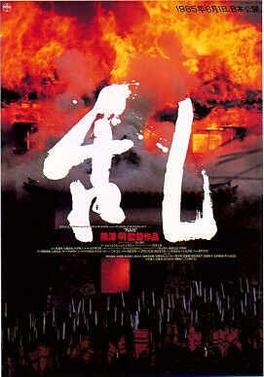
IMDb #132 Review: Ran (1985)

Source: Wikipedia
Shakespeare's King Lear in feudal Japan? Akira Kurosawa movies in color? One's good; both are better; combined, they're a tactical nuke to the eyeballs.

A wild-eyed old warlord has three sons, creatively named First Son, Second Son, and Third Son.

A time-tested moron, the old man trusts the two suck-ups, but banishes the loyal son who dares question his dad's dumb decisions. To the surprise of absolutely nobody, this turns out to be a shitty idea. The heir takes over before Dad's kicked the bucket, then kicks out his dad to boot (and a handful of loyal retainers). The other son schemes to usurp the usurper, provoked by his scheming wife Kaede (best described as: crouching violet, hidden HOLYSHIT BADASS PSYCHOBITCH).

The ponderously slow windup is worth the wait -- fully charged, the potential energies ignite a perpetual bloodbath machine. And of course the destruction looks wonderful. The castle siege. The color-coded clash of armies. The well-intentioned but disastrous plot to return the deposed lord to power and sanity.

The colors. Did I mention the colors? Because they're amazing. The kimonos, the armor, the interior decoration, and oh so much fire. Zero CGI, just colors and motion.

Hell, I'll say it -- this is probably the most beautiful live-action movie I've ever seen. To dump more hyperbole fuel on the blazing altar-fire of ego-wank.

Like absolute statements and rave reviews, you don't need a Shakespeare background to understand the story, but it provides excellent shorthand. Literature scholars recognize certain elements. Poetic irony and senseless tragedy, often the same thing; on-again, off-again mental illnesses; surprisingly convincing disguises; the "wise fool" archetype (who has no equivalent in ancient Japan and instead seems like a lost time-traveler gone mad with boredom for lack of Internet). And death, death, death.

What were you expecting from Shakespeare, a happy ending?

Watch it. For the plot, for the spectacle, just to say you did it, who cares, just do it. A Kurosawa epic is more than mere entertainment. This is ART.

160 minutes.