Showing posts with label Hayao Miyazaki. Show all posts

Wednesday, August 19, 2015

IMDb #127 Review: My Neighbor Totoro (1987)

Source: Wikipedia
A father and his two young daughters move to an old house in the country, which stirs up the local population of magical and possibly imaginary creatures.

How does Miyazaki, an elderly Japanese workaholic, so effectively capture childhood whimsy? Probably in an electrified cage, hooked up to an automatic milking machine constantly pumping rainbow-hued imagination-goop from its bulging udders.

Toss back a warm glass, friends, things are going to get weird.

Japans's preemptive retaliation for Pan's Labyrinth features the Miyazaki hallmarks you might recognize by now. Lush art and animation. Obligatory flying sequences. Spunky heroine(s). Great music courtesy of longtime collaborator Joe Hisaishi. And, this time, a profound absence of violence or harsh language or anything remotely objectionable, barring a brief scene of communal bathing probably put in to freak out the Americans.

So the kiddos whiz around the house like tiny drunk people and discover weirdness popping out of nooks and crannies. Living coal-dust puffballs snuggle in the walls and attic and under the floorboards. A cat-bus with spotlight eyeballs and luminescent mouse taillights wanders the hills. Near the huge tree out back, the toddler tumbles down a tunnel and lands on the tubby belly of a fuzzy snoozing beastie. The eponymous Totoro.

Wacky inexplicable adventures occur.

Yes, it's a perfect children's movie, but it doesn't lie to its audience for a minute. Yes, kids, there's awful shit in the world, and magic shit won't make the awful shit go away. Their mom's sick and dying and the family has to prepare for that. Sure, magic can make plants sprout sky-high in seconds (then suspiciously creep back to millimeters-high in the morning) but can't fix their money issues for them.

The hardworking dad looks baffled but remarkably accommodating to all this weirdness he can't see.

Does that mean none of the magic is real? People who ask that question, I attribute the same amount of credibility as the theorists who propose that Totoro is a metaphor for the nuclear bomb. In the unlikely scenario that's true, it remains far from the strangest thing to spring from Miyazaki's bottomless weirdness reservoirs, or wherever he gets his ideas.

86 minutes.

Tuesday, August 4, 2015

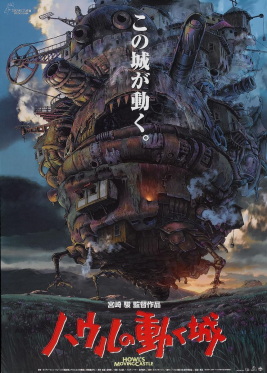
IMDb #142 Review: Howl's Moving Castle (2004)

Source: Wikipedia
Sophie, a simple girl from a pseudo-Victorian haberdashery, runs afoul of shapeshifting shadowmen. (Who doesn't, from time to time.) Then a spiteful morbidly obese witch transforms the young girl into an old crone. So Sophie seeks help from Howl, a vain magical manchild who lives in a mobile steampunk fortress that walks on impossibly spindly legs.

Never change, Studio Ghibli.

Once again, Miyazaki dials up the WHIMSY meter till the needle breaks the scale and the compression tank explodes and ingenious creations of pure joy rain from the sky. A friendly mute hopping scarecrow. A snarky omnivorous fire demon voiced by Billy Crystal. A wheezy stubby-legged dog-mop-thing. A magic teleporting door. Monstrous wizard birdmen. And Howl.

(See, typically I'll list a catalog of disparate elements to amuse, confuse, or spark the imaginations of readers as they attempt to deduce the connections. For anything Ghibli, good luck. Just settle down deep into the weirdness, drink in the staggeringly beautiful sights and sounds, and let the warm fuzzies wash over you.)

While this likably practical girl adjusts to the prospects of playing elderly housekeeper to a fickle boy wizard, the land is at war. Who, why, and precisely where? Answers would ruin the effect. Nevertheless, the king summons wizards to fight for him. Howl (and his multiple aliases) dodge the draft, insisting (in curious unison) that the war is pointless. Besides, he's beginning to see his housekeeper for the true beauty inside, and on the outside when she's asleep.

Because amid the adventures and escapades and air raids, there's room for a disarmingly sweet romance arc.

Just as the wild inventiveness never becomes alienating, the colorful cast of characters remains unmistakably human in the oddest ways.

Every frame drips beauty. I want to catch it in a jar, set it up to sparkle on a shelf, or guzzle it all down at once to feel it flutter in your gut. Or, best of all, pour it out and set the warm fuzzies free.

119 minutes.

Wednesday, June 10, 2015

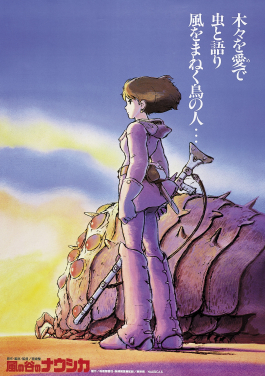
IMDb #196 Review: NausicaƤ of the Valley of the Wind (1984)

Source: Wikpiedia
Miyazaki's first original movie establishes the blueprint for all the others to follow. Kickass heroine? Top-notch animation, music, storytelling? Heavy-handed environmentalist subtext? Gratuitous flight sequences? All that and more.

As the clunky opening narration informs us, the evil industrialist society was razed by fire-puking Evangelion prototypes. In the resultant wasteland, agrarians eke out a meek existence in the Valley of the Wind, where the sea breeze wafts away poisonous spores.

The dominant species on this hellish world is the gigantic psychic trilobites who've never heard of the Square Cube Law.

The titular heroine loves these freakish physical anomalies. She's so self-sacrificial, so all-embracing, her Messiah complex could engulf planets. Though her name stems from a minor character in Homer's Odyssey, her odyssey is quite different: save every insect, every human. She talks to herself a lot, and to animals. She's no Gandhi, as her kill list attests. But her weepiness shows she at least feels bad about it.

Chocobo-riding Gandalf brings bad news to the idyllic village. The evil morally ambiguous empire is spreading, and so is the toxic jungle. Coincidentally, a foreign airship crashes in their valley, leaving an embryonic humanoid bio-weapon. The evil empire wants this thing. So the messianic princess NausicaƤ goes with the morally ambiguous empire princess on adventures. Like getting involved in stratospheric airship battles, picking up an unnecessary totally-not-a-love-interest (voiced by Shia LaBoeuf?!), and incrementally advancing the plot.

Meanwhile the village in the valley rankles against their imperial overlords, especially the princess's assistant, a deliciously cynical coward. Via politically complex shenanigans, they end up in the path of a rampaging herd of pissed-off giant psychic trilobites. It happens.

The animation isn't as polished as Spirited Away, but for the eighties, it's magnificent. The music isn't my favorite of Joe Hisaishi's, but it's still splendid. And the spotty, stuffy English script is wonky but workable. (Go Disney dubs!)

The only real surprise in store is how astonished the characters are that our messianic archetype protagonist fulfills the requisite ancient prophecy.

117 minutes.

Wednesday, April 29, 2015

IMDb #236 Review: Castle in the Sky (1986)

Source: Wikipedia
Strap on your steampunk goggles for the ultimate rollicking yarn from Studio Ghibli, an adventure about a pigtailed princess and her magic rock and the enormous tree they send soaring into the mesosphere.

But seriously? It’s gold. Hayao Miyazaki, the Japanese Disney, strikes again.

A girl drops into a mining-town monkey-boy’s life–shenanigans commence. Pirates pop up, a posse of ponces headed by a motherly shrew chasing after the ingenue’s sparkly plot token. Then the military rolls in with their anachronistic arsenal. The countryside explodes into mayhem and sweet, sweet prepubescent romance.

Expect the Miyazaki hallmarks. Flight sequences (more than usual), evil government, gray morality, funny background events, blatant environmentalist messages. Also, some of the finest hand-drawn animation in the business. Glass, water, clouds, and DESTRUCTION have seldom looked so good.

Even better, the Disney dub adds flavor to a quiet film. Bonus orchestral music by Joe Hisaishi. Funny throwaway lines. And a cavalcade of big-name voices.

To wit: Mark Hamill cavorts as the exposition-happy villain. Cloris Leachman squawks as a feisty old buccaneer lady. Anna Paquin, as the heroine, occasionally slips into her adorable native New Zealand accent. As far as dubs go, not bad.

Space left over? Story time. Miyazaki named the floating continent Laputa after a location in Gulliver’s Travels. Strangely, the great director neglected to recall that Jonathan Swift was a satirist–in Spanish, “la puta” translates neatly to “the whore.” The film might’ve proven difficult to market in Spanish-speaking countries.

Recommended for adventurous adolescents, picky snobby discerning otaku, and recovering acrophobes.

126 minutes.