Showing posts with label based on a true story. Show all posts

Friday, August 28, 2015

IMDb #118 Review: The Great Escape (1963)

Source: Wikipedia
A bunch of guys dig out of a German POW camp, or they do what they can before the Angel of Murphy strikes and the whole operation goes FUBAR. Movie notwithstanding, I fail to see what's so great about it.

Probably the cast. An impressive array of strong-jawed leading men who are wrinkly or dust by now. Or the criminally catchy theme tune which elevated these dusty supermen to celluloid immortality.

A parallel to the casting calls, all of the English-speaking escape experts are packed into one camp. Which is as "inescapable" as those in the other movies of its ilk. Germany is asking for trouble here. "All the rotten eggs in one basket" doesn't make for clever war strategy, unless you mean the second-worst Easter surprise ever.

Unlike the outside world, everybody inside has a job. Diggers, forgers, carpenters, structural engineers, tailors, moonshiners, and ... gardeners? Christmas carolers? For cover, obviously. Good thing the story skips the majority of the mind-crushing monotony, such as the countless hours Steve McQueen spends in solitary confinement not growing facial hair.

The plan? Liberate 250 men. The reality? Well, for a visual demonstration, toss a dirt clod into an oscillating fan. The few survivors scatter across occupied territory (and what lovely occupied territory -- you almost forget it's ruled by Nazis, or worse, the French).

They borrow or hijack bikes, boats, trains, planes. The French Resistance attempts to assist any who catch on to their act. But English idiomatic politeness threatens to undo them all. Rather anticlimactic.

The title didn't lie. The escape plan was pretty great. The greatest part of the execution is that anything worked out at all. (And the execution of the recaptured escapees, now, that's why they left in the first place.)

Thursday, August 13, 2015

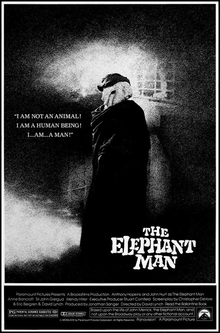
IMDb #133 Review: The Elephant Man (1980)

Source: Wikipedia
A hideously disfigured gentleman goes from being the gawking curiosity of moral degenerates to...a gawking curiosity for London's rich and famous.

Upward social mobility for the grievously handicapped? Top marks, Victorian England.

An esteemed doctor discovers the poor fellow as a back-alley attraction. He rescues the wheezy bag-headed chap from his cartoonishly evil self-appointed owner.

The elephant man, so named for the herd of elephants that trampled his pregnant mother and thus caused his deformity (dammit, Victorian England), becomes the talk of the Royal Society. And the bane of the hospital wait staff.

Most visitors experience difficulty ignoring the Elephant Man in the room. But slowly, they realize he's human. Kind. Intelligent. Even charming. He cannot leave his well-furnished hospital room, so to bring him into London society, they bring London society to him.

Not that the gutter-dwellers have forgotten him. They plague him, every hobbling step of the way.

One neat thing I noticed: the audience's journey parallels the characters'. For the first half-hour, the camera doesn't display the John Merrick's full face. Suddenly there's a full-frontal view, in all its swollen glory. But, over time, we become acclimated and grow to see the man inside the body.

The presentation adds to the effect. The black-and-white aesthetic recreates the past as seen in old photos, and creates a masterful atmosphere of discomfort. The makeup is horribly convincing. The soft, sweet soundtrack paints an eerie backdrop on the gray canvas. And on that backdrop the cast nails brilliantly nuanced performances. (Except for the gleefully sadistic one-dimensional villains.)

Speaking of which. Having experienced high society only makes it worse when blackhearted bastards drag the celebrity back into a freak show (in continental Europe, so MUCH WORSE). But tragedy leads to triumph, as the other "freaks" -- midgets, giants, conjoined twins -- recognize that he doesn't belong among them, and lend helping hands. Or flippers.

And because the universe is unspeakably cruel, this (admittedly streamlined) true story continues to the bittersweet end.

It's uncomfortable. But, as the uncomfortable becomes comfortable, it becomes uncomfortable to think that I felt uncomfortable in the first place.

124 minutes.

Saturday, July 25, 2015

IMDb #151 Review: Judgment at Nuremberg (1961)

Source: Wikipedia
The U.S. of A commissions a wise old judge from Middle-of-Fucking-Nowhere, Maine, to relocate to Germany for the incredibly difficult task of legally determining whether the Nazis were bad people.

Not as simple as it sounds.

The defendants -- judges, now undergoing judgment -- were just doing their jobs when Hitler decided to run things. Can these men be blamed for obeying the (flagrantly racist) laws of the land? The prosecution thinks so. Then again, the rabid nationalistic American officers had the delightful pleasure of liberating Dachau. Slight prejudice there.

However, the judges have a kickass defense lawyer. His passion sizzles for justice, loopholes, and moral ambiguity.

These three hours are the slowest burn I've ever seen passed off as a movie. Serious men talk in a room, and occasionally shout. The camera circles speakers like a hungry vulture. Various witnesses occupy the stands: a skittish lady with a sordid romantic history, a chemically castrated old man, and (in spirit) over six million dead Jews.

The lawyers delve into the racist ruling of a past case, harping on minutiae. Until the Americans bring out legitimate Holocaust footage. (In a Bad Things To Do contest, tough to beat genocide.) Somehow, the sad old white guys find the guts to repeat, "Not guilty, not guilty."

As the case wears on, the increasingly weary judge acclimates to postwar Germany. Amid the bombed-out shell of a city, he lives in a mansion, and somehow meets and dines with the widow who used to live there. He also finds it to be in poor taste to ask the serving staff about the concentration camps.

Did the German people know the extent of Hitler's atrocities? Good question. The kickass defense lawyer indicts the whole world, who knew of the Nazi party's intentions years in advance, yet did nothing. And the Americans, who nuked Japan. He demands to leave a shred of dignity, of autonomy, for the German people. As if that's an easy thing.

But the old backwoods judge feels he must vote his conscience. Especially if the decision is unpopular.

All in all: gray, gray, gray. Not just because the movie's in black and white. Not because it's white guys in dark suits sitting in a room. But because the morality is so obscure, the presentation so dry, and the outcome so bleak.

So this (fictionalized) judge votes his conscience for these (fictionalized) war criminals. In one major sense the film parallels reality: by the time this movie was made, the (real) decision didn't matter anymore anyway.

179 minutes.

Wednesday, July 22, 2015

IMDb #154 Review: A Beautiful Mind (2004)

Source: Wikipedia
An asocial mathematician finds love and meaningful work at Princeton -- then nearly loses it all to people and things that exist inside his brain. Schizophrenia's a bitch. And it's worse when you don't even know you've got it.

So the math dweeb starts out in college. He doesn't like people; they reciprocate the sentiment. Eccentric, unfocused, yet inexplicably arrogant, he chalks equations on windows, drinks with the boys, and fails to seduce women by plainly stating his intentions. He has zero accomplishments to his name, until he craps out a simple formula to overturn Adam Smith's capitalism, a paper whose influence doesn't become apparent until he's a wrinkly old guy.

He grows up to suck at teaching, and attending his to his wife's needs, and living in reality.

Seeing things from his perspective, the audience doesn't know what's really real (or not) until he does. It's disorienting. Unsettling. Sobering to think: What would convince you that certain facts you know just...aren't?

Well, the genius has to swallow his supermassive ego and strive for the consensus reality. Because the imaginary can't coexist with the real. And certain medication can't coexist with his higher cognitive functions. After a lifetime among sweet lies, he makes his choice.

This just-about-true story displays how love, made of chemicals in the brain, can triumph over paranoia, other chemicals in the brain. How love, which our hero compares to the infinite of the universe, can conquer the demons of mental illness. How one can only find logic in love, the most blissful state of illogic.

(And then the real John Nash goes and dies in a taxi cab crash in March 2015, because the universe is just awful like that.)

135 minutes.

Saturday, July 18, 2015

IMDb #158 Review: Into the Wild (2007)

Source: Wikipedia
A college student graduates with all the education, friends, money, and potential he could ever want. Problem  -- he doesn't want it. So he ditches his troubled family, burns his savings, abandons his car, and bums around America for a while. The ultimate goal: Alaska.

This earnest young man seeks REALITY and TRUTH. He conveniently ignores the REALITY that his sudden disappearance plunged his (flawed) family into unspeakable pain and the TRUTH that he regularly flouts the law and gambles with his life and can't trust luck to protect him forever.

It's still inspiring, and all that crap. In the tender years of early manhood, this guy goes out and does crazy things. While I write about movies and you read about it.

Tired of things, he works on a farm in South Dakota. Under the name Alexander Supertramp, he hops on a hippie wagon by the California shore and rekindles a starchild romance. He paddles down a river, lacking a license or any relevant experience, and dodges the river patrol in time to run into Danish tourists with lax standards of public nudity. He sneaks in and out of Mexico just to prove he can. Short on cash, he works fast food, with no identification or permanent place of residence. He sprouts a magnificent hobo beard.

And finally -- chronologically interspersed with these other adventures -- he hitchhikes, then hikes, to Alaska. To live off the land and read and sleep in a convenient abandoned bus.

"If you want something in life," he preaches, "reach out and grab it." Unfortunately, LIFE is a petulant bitch who resents unsolicited groping. She gladly recompenses amorous advances with a slap in the face and a knee in the crotch. As he learns, in his attempts to subdue the Alaskan wilderness with aught but his wits and naivete.

(Starving is a shitty hobby. But so's wasting ammo because you never learned to shoot, and raising an impromptu maggot farm on meat you never learned to preserve.)

This remarkable epic is based on a true story, admittedly with some fictional elements (a nudist colony with attractive people in it? Impossible). But the lesson remains just as true. After all the books, experiences, reflections in solitude, what does he learn, thanks to the famous wise hobo Tolstoy? HAPPINESS IS ONLY REAL WHEN SHARED.

(Agreed. Because as much fun as it is churning out jokes for the Internet, it's even better knowing someone read it and had fun. Maybe even emitted a pitiful snicker.)

148 minutes.

Thursday, July 16, 2015

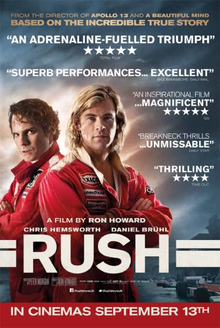
IMDb #160 Review: Rush (2013)

Source: Wikipedia
Formula 1 -- NASCAR for sophisticates, for enlightened connoisseurs of expensive cars driving in circles really fast and exploding.

Apparently this is serious business. Especially for two diametrically opposed superstars. Scrawny Austrian car nerd Nikki Lauda gives up a successful future in finance to drive in circles really fast. Beefy beach-blonde British playboy James Hunt presumably considers cars a negligible distraction from women and booze.

But as our chiseled long-haired demigod says, the racing is incidental. It's the personalities, the competition, the brain-boggling piles of cash sunk into these races. And the closeness to death makes them so attractive to women. At least for him (heads up: plenty of luscious lady-flesh) -- so long as he's winning.

These guys have one thing in common: they alienate their families, ditch potentially stable careers, to taunt death driving "bombs on wheels."

Our joint heroes meet in the minor leagues, where it's hate at first sight. The rivalry spans years. One wins, the other wins, and sometimes some irrelevant dude wins. James Hunt goes through women like toilet paper; the abrasive Austrian plops into a lovely love life which, if it weren't based on fact, I'd condemn as improbable fiction.

The cinematography makes the movie. It's quick, tense, up-close-and-personal. Expect POV wheel shots and close-ups of eyes and axles. The races travel to exotic locations around the world -- from Brazil, South Africa, Spain, Monaco, Germany -- different title cards for slick asphalt tracks.

But priorities change. The promise of glory, the fear of horrible flaming death, grows complex when both guys have spouses to support. So as they yo-yo in and out of slumps, and when the wheeled bombs blow up in their faces, they might finally learn to respect each other. Even if they can't like each other, they can become like each other. Let respect and envy drive them both to greatness.

If that's how you wanna look at it, at the finish line, everybody wins.

122 minutes.

Saturday, July 11, 2015

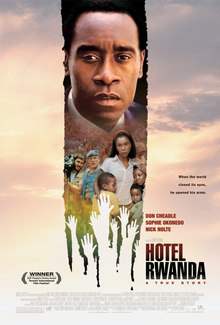
IMDb #165 Review: Hotel Rwanda (2004)

Source: Wikipedia
When the tiny Central Africa nation erupts in a genocidal bloodbath, the manager of a ritzy hotel hits limit on neutrality and relying on the moral qualms of rich white people.

Stay out of trouble, he says, and protect your family, because family matters most. Then trouble actually comes. Tough to stay calm when you're knee-deep in corpses.

Hold on, back up. It's urbanized Africa, mid-nineties. People seem to seize any excuse to feel better than other people, so racism is embedded in human nature, and skin color makes for a very visible excuse. In this case, Hutus and Tutsis were arbitrary distinctions set up by the occupying Belgians. Decades later, pissed-off Hutus want revenge for Tutsi injustices toward their parents and grandparents. A caustic radio program spurs the hateful Hutus to machete-swinging massacre.

This puts our protagonist in a predicament. He's Hutu, married to a Tutsi, with no strong feelings either way. Effectively westernized, he runs a posh joint for visiting dignitaries. All his problems he smothers with style -- poise, class, elegant lies. But smiles and bribes can't block bullets.

When destitute refugees flock to him, bloodthirsty mobs in pursuit, he appeals to UN Peacekeepers (200 assigned for the whole country, and they can't fire a shot) and the guilt of Western powers (who don't want to get involved, just like the hero himself before the problem plopped on his doorstep).

Essentially, reality hacks a civilized man's ideals to pieces, which bleed out face-down in the dirt. He grows increasingly haggard as the body count racks up and even more angry dudes with guns yell in his face.

At last, in a borderline parody of "white people to the rescue," a team of volunteers extracts the refugees piecemeal from the hotel's ruins. Not that it's easy, or a bloodless transition. But thanks to them and people like them, there's this story to tell.

A story which I've hardly heard till now. Because, over one million bodies later, it seems nobody's learned a thing.

121 minutes.

Monday, June 29, 2015

IMDb #177 Review: 12 Years a Slave (2013)

Source: Wikipedia
In a rare riches-to-rags progression, a 1840s black Yankee freeman gets yanked aboard the Reverse Underground Railroad and endures the titular dozen years of excruciating brutality.

Humor deserts me.

Even Hans Zimmer's ordinarily zesty strings are subdued.

This guy loses his wife, kids, house, even his name. Thanks to the giddy top-hatted fops who abducted him, our hero suffers under rich white jerks of varying degrees of racism. They range from gently insensitive to violently abusive.

Worse, the hero knows of a better life. Not that it does him any favors. Intelligence? Reading? Enough character to suggest more efficient work methods? Punishable offenses. Only his violin skills procure him special jobs, which designate him as the unfitting cheerful accompaniment to deplorable horrors.

Such horrors include picking cotton; cutting sugar cane; attending to the master's, ahem, needs; and attending Sunday sermons that twist Scripture to support slavery.

Doing your job and not doing your job can both result in beating or whipping or whatever the white masters feel like today.

The camera, when not panning over emaciated bodies or equal-opportunity full frontal nudity, favors claustrophobic close-ups of faces contorted in agony. It's an apt microcosm of the film: an uncomfortably intimate depiction of human suffering. Nothing sadistic or voyeuristic about it -- just plain pain.

Barely recognizable, producer Brad Pitt inserts himself as an enlightened Jesus-lookalike Canadian. He preaches the unwelcome gospel that blacks are people and deserve to be treated as such. He couldn't have cameoed at a better time -- well, twelve years earlier, but that's that.

This movie, like slavery, is soul-shredding to ponder for any extended length of time. Its impact is undeniable. Obsessing over it won't fix the past; ignoring it won't make it go away. It demands acknowledgement, lest we climb back into our comfort-padded prison cells of blissful ignorance.

134 minutes.

Thursday, June 18, 2015

IMDb #188 Review: In the Name of the Father (1993)

Source: Wikipedia
Since it is set in turbulent twentieth century Ireland, this movie starts in medias res with a bang, gets back to the bang, then features a series of smaller, more emotionally potent bangs till the closing credits.

The hero, a longhaired punk, lives in IRA-ravaged Belfast with his buds. Their white-collar dads ship them off to London to grow up. Every fun thing our hero does there acquires sobering significance. He shacks up with a hippy commune. He plunders a hooker's sex dungeon. Homeless and penniless, he squabbles with a hobo over a monogrammed bench.

Then a pub blows up. He's extradited from Ireland. Through torture, the British justice system (composed entirely of angry men in suits) convicts him of the bombing. Moreover, his family and friends are railroaded as criminal associates.

The courtroom drama transitions to a prison drama. As cellmates, the straitlaced dad and wayward son get all the quality time they were missing. Years and years and years of it. Even after the justice system catches and convicts and incarcerates the real IRA pub-bombers.

Furious yet? Good. Because it's based on a true story, which manages to be even more depressing.

The film dodges melodrama by rays of hope. Inspiring moments of prisoner solidarity. Picketing protesters and a lone lawyer campaigning for their release. The emotional yo-yo of a strained father-son relationship. Intense instances of Daniel Day-Lewis's insane method acting.

And when the critical evidence comes to light, your heart spreads broken wings and soars. Kinda. Then the ending, and the awful reality behind it, sticks in your chest like a pulmonary embolism.

133 minutes.

Saturday, June 13, 2015

IMDb #193 Review: Hachi: A Dog's Tale (2009)

Source: Wikipedia
This super-saccharine sorta-true story tastes like a marshmallow pie with a needle in it.

A music prof picks up an abandoned puppy at a train station. The wife freaks out--she cranks up the marital strife thermostat until puppy love infects her too. Nobody claims the pup; the pound would give him two weeks, then ice him. So, adoption remains an option. The pet grows on the family like a fuzzy tumor.

The titular pooch, as the hero dude discovers using the arcane pre-Google Internet, is a rare and ancient breed from Japan. His token Japanese friend/kendo buddy (what, you don't have one?) says the breed is smart, loyal, and sucks at fetch.

Instead, Hachi proves adept at escaping: dig under the fence, hop over it, or even open the latch like a tiny furry velociraptor. He experiences the abounding love of the small town's inhabitants via knee-high shaky-cam monochromatic dog-o-vision.

Merely commuting to work becomes a recipe for canine hijinks.

But the dog grows up. The kids grows up. This being a family picture, innocuous physical comedy spontaneously generates. Such as some dude awkwardly attempting to woo the musician's daughter.

THEN TRAGEDY STRIKES. Without warning, with staggering consequences, as it tends to.

The second half of the movie is nonstop sentimental longing for the first half. The lilting piano refrain tugs on the heartstrings with dull little teeth.

Gimmicky? Hell to the yes. It's indisputably crack for dog lovers, laced with sentimentality and possibly tear gas.

The film sparkles with family friendliness, aside from implied marital intercourse and, you know, acknowledgement that death exists.

So we watch nice people be nice people, then suffer and die for no explicit reason. The proffered treatment for grief is to dig your heels into the dirt and never let go of the happy past. Because of course that'll bring it back. Nah, it's just easier than moving on.

On which note, moving on.

93 minutes.

Sunday, May 10, 2015

IMDb #225 Review: Memories of Murder (2003)

Source: Wikipedia
Being a detective sucks anywhere in the world. Welcome to South Korean mid-eighties true crime, which translates to:
  1. It’s not North American.
  2. It’s gruesome, grueling, frustrating, and crushingly depressing.
  3. Typewriters, tape recorders, rotary dial phones, and godawful CRT-TV resolution remind us that technology evolves but people remain morons and/or bastards.
The tagline -- “The true story of an unsolved crime under military dictatorship” -- should have been the first sign we weren't in for a barrel of laughs. That, or the opening shot of a girl dead in a ditch. Or the cops torturing a mentally retarded man to get a confession, though admittedly the tone was difficult to define due to the nonexistent soundtrack.

Not a happy story.

As spoiled by the tagline: expect zero closure. Escapists beware.

A rural police department tracks down a bad boy who likes to rape and strangle pretty girls. For a personal touch, he stashes various objects inside their body cavities. Like peach slices. In their, uh, peach slices.

Totally stumped, the detectives import a hotshot young detective from Seoul. This college-educated upstart introduces such revolutionary tactics as DNA testing, interviewing instead of torturing potential suspects, and reasoning from extant evidence.

Local cops ain’t down with that. They prefer the tried-and-true methods. Namely, relying on intuition to pick which suspect to torture for a confession. Conflicting tactics result in a clash of departmental priorities. But maybe the factions are more alike than they think. After months and months of failure, the easy way out looks more and more tempting.

Being cops, the sort-of-heroes process a revolving door of disturbing characters, who may or may not have anything to do with the case. Battered witnesses, likewise.

For Western viewers, there’s an exotic setting. Karaoke, chopsticks, ear-cleaning, and Korean barbecue allay the depressing madness with learning about another culture. Unfortunately, we also learn their humans are just as flawed as ours.

Recommended for free-roaming psychopaths, closeted necrophiliacs, and the twisted masochists who lap up gritty realistic police procedurals.

127 minutes.

Saturday, May 9, 2015

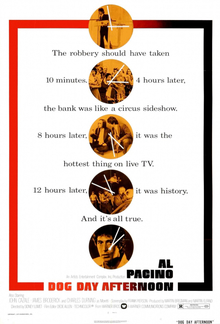
IMDb #226 Review: Dog Day Afternoon (1975)

Source: Wikipedia
You just can't make some shit up.

Like the guys who robbed a New York City bank to pay for the leader’s boyfriend’s sex change operation. Well, try to rob a bank. Spoiler alert: it's harder than it looks in the movies. Anything can and will go wrong.

Consummate character actor Al Pacino plays a disgruntled Brooklynite with a hot head and a soft heart. Despite his best-laid plans and banking know-how, Murphy’s Law deals him a doozy. One partner chickens out. The other gets antsy. The cops show up, then the TV guys. The hostages gripe. The AC unit conks out, drenching them in the dead heat of August.

Tensions escalate.

The cops drag in people to talk him down. His chatty chubby wife; his frizzy neurotic man-wife Leon; his doting but delusional mother. All to no avail — our anti-hero screams and swears and sweats it out.

The suspense is exhilarating, exhausting. The dialogue is raw. It all feels unbelievably real. (Fitting, because it was.)

For analytic critics, there’s plenty of fodder ripe for interpretation. A critique of capitalism that drove a man to crime. A mockery of fame worship, exemplified by the pizza boy ecstatic about being on TV. A lower-class mistrust of civic authority, represented by the public disdain of police and adoration of these gun-toting maniacs. Or a sympathetic depiction of closeted gays in the seventies.

Or, you know, a fictional analogue of a real event, with no hidden message except entertainment and madness and whatever underlying meaning you attach to reality.

Recommended for any hopeless soul who feels trapped in a stifling marriage or job or gender, any dashing desperado brave and/or dumb enough to risk everything to get shot in the face.

125 minutes.