Showing posts with label World War II. Show all posts

Saturday, August 29, 2015

IMDb #117 Review: Downfall (2004)

Source: Wikipedia
More Nazis? If movies even somewhat capture reality, then the Second World War was the most happening place in the history of the universe.

But this time the tables are turned. Then overturned, then burned to smoldering embers. This take on European Armageddon reflects a radical perspective -- the fall of the Third Reich, as seen from inside Berlin. Directed by legitimate Germans. With narration by the lady who was actually there in the bunker with Uncle Adolf. Hardcore history.

Back in the day, when she was young and naive and typed as well as Stormtroopers shoot, she was Hitler's secretary. The dictator dictates, the transcriber transcribes. Early on, when the war went well, he proves remarkably forgiving of the new girl's abundant typos.

In the last days, as Berlin cracks in the vise-grip of the Russian war machine, the Aryan Antichrist displays less composure. He's angry, stubborn, and worst of all, stupid. He shouts that his generals have betrayed him, and thus ignores their good ideas to stick to his own delusional tactics. His closest advisers fear to contradict his anti-logic.

These represent one of three camps on the Nazi sinking ship. The high-ranking officers who grimly remain at their posts, even as their pant legs grow worryingly soggy. More exciting are the party animals who throw frenzied orgies as the buildings shake and the electricity stutters. Less fascinating but more practical, the sane remnant who don life preservers and hop off the boat -- they risk being shot as traitors by their own people as well as the rising Soviet wave.

A handful of stories run parallel and intertwine. In the bunker, the secretary watches her national hero melt down like Chernobyl and feels the fallout poisoning everybody int he vicinity. Elsewhere, a father struggles to reclaim his suicidally patriotic son from the Hitler Youth. A doctor wants to leave but remains behind to aid the wounded, even though he's not a medical doctor, even though his job entails sawing off limbs without such luxuries as anesthetic.

Eventually even the truest believers realize all is lost. The Reich's most elite suicide club follows through with their black pact. The saddest case? The Goebbels family -- the perfect doe-eyed Aryan children sing to the disconsolate Fuhrer. At their doting mother's insistence, they pass around a cup of "medicine" like the worst Communion ever.

The mood of palpable desperation melts into raw despair. The combat is anything but glorious -- loud, messy, ugly as sin. And when the designated good guys win, the "where are they now" credits hit like a shower of icewater. And the thralls of history's monsters look disturbingly human.

178 minutes.

Thursday, August 20, 2015

IMDb #126 Review: The Bridge on the River Kwai (1957)

Source: Wikipedia
If war is hell, Japanese POW camps were Hell 2.22: Don't Look Now, But the Thermostat's Broken.

If, Satan forbid, hell ever invited the British, there'd be a reckoning. Dapper gents with stiff upper lips tactfully but firmly critique the infernal management, assume control of operations, and streamline the organizational structure to dramatically increase torment efficiency and simultaneously blast the front door wide open so the damned can just waltz out whistling "The Colonel Bogey March."

This happens, more or less.

In the Southeast Asian jungle, a remote prison camp receives a shipment of Brits. The commandant puts them to work building a rail line from Bangkok to Rangoon, on a schedule that keeps slipping back. But the limey boss, a colonel, maintains a strict set of standards. He won't let officers do work. He suggests alternatives, backs up his claims with the Geneva convention, and for his trouble spends much of the movie in solitary confinement. Ultimately, he inspires the men to do the best work they can. Not to aid the evil empire, but to keep up morale.

Meanwhile, the crass American hero just wants to get out of there. So long as the heat, humidity, sickness, snakes, and flying bullets don't take him out first.

British cheek and American pluck clash with Japanese disciprine. It drives the commandant bonkers. And as fast as the colonel's boys build the titular bridge, Allied commandos move to blow it up. There's no more room for Stockholm syndrome in this story than there is for significant female characters in your basic war movie.

If this whole scenario sounds implausible to your cynicism-stoppered ears, rest assured. There is a reckoning to the reckoning. For all the inspirational international cooperation, the end retaliates with the disastrous consequences of blisteringly stupid misunderstandings. Not to say it's bad -- I'll have you know it's satisfying as hell. Or as satisfying as watching hell blown open by British ingenuity unknowingly collaborating with American accident.

161 minutes.

Saturday, July 25, 2015

IMDb #151 Review: Judgment at Nuremberg (1961)

Source: Wikipedia
The U.S. of A commissions a wise old judge from Middle-of-Fucking-Nowhere, Maine, to relocate to Germany for the incredibly difficult task of legally determining whether the Nazis were bad people.

Not as simple as it sounds.

The defendants -- judges, now undergoing judgment -- were just doing their jobs when Hitler decided to run things. Can these men be blamed for obeying the (flagrantly racist) laws of the land? The prosecution thinks so. Then again, the rabid nationalistic American officers had the delightful pleasure of liberating Dachau. Slight prejudice there.

However, the judges have a kickass defense lawyer. His passion sizzles for justice, loopholes, and moral ambiguity.

These three hours are the slowest burn I've ever seen passed off as a movie. Serious men talk in a room, and occasionally shout. The camera circles speakers like a hungry vulture. Various witnesses occupy the stands: a skittish lady with a sordid romantic history, a chemically castrated old man, and (in spirit) over six million dead Jews.

The lawyers delve into the racist ruling of a past case, harping on minutiae. Until the Americans bring out legitimate Holocaust footage. (In a Bad Things To Do contest, tough to beat genocide.) Somehow, the sad old white guys find the guts to repeat, "Not guilty, not guilty."

As the case wears on, the increasingly weary judge acclimates to postwar Germany. Amid the bombed-out shell of a city, he lives in a mansion, and somehow meets and dines with the widow who used to live there. He also finds it to be in poor taste to ask the serving staff about the concentration camps.

Did the German people know the extent of Hitler's atrocities? Good question. The kickass defense lawyer indicts the whole world, who knew of the Nazi party's intentions years in advance, yet did nothing. And the Americans, who nuked Japan. He demands to leave a shred of dignity, of autonomy, for the German people. As if that's an easy thing.

But the old backwoods judge feels he must vote his conscience. Especially if the decision is unpopular.

All in all: gray, gray, gray. Not just because the movie's in black and white. Not because it's white guys in dark suits sitting in a room. But because the morality is so obscure, the presentation so dry, and the outcome so bleak.

So this (fictionalized) judge votes his conscience for these (fictionalized) war criminals. In one major sense the film parallels reality: by the time this movie was made, the (real) decision didn't matter anymore anyway.

179 minutes.

Tuesday, May 26, 2015

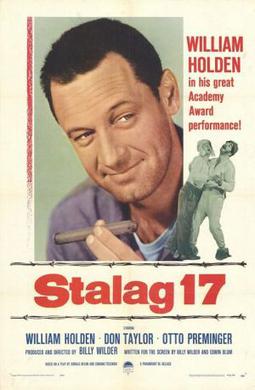
IMDb ??? Review: Stalag 17 (1952)

Source: Wikipedia
Important historical distinction: Nazi POW camps were nothing like concentration camps. POW camps were more like shitty low-budget Jesus Camp with machine guns, and concentration camps were concentration camps.

Instead of dying horribly, captured American soldiers bum around, try to escape, then die horribly for trying to escape.

Prisoners fritter away the hours with games like horseshoes, chess, and smuggling contraband. Cigarettes hold strong as currency. Behind closed doors, men indulge in potato skin liquor, literal rat races, and Russian women prisoners within telescope range.

The cast represents the typical motley crew. Cynics, clowns, hotheads, horndogs, psychos, snitches. That’s right–after enough shenanigans implode, the guys conclude there’s a snitch in their barracks. And, spoiler alert, they’re right.

Like most movies about grown men forced into intimacy, this film showcases human brotherhood under duress, and just how quickly it breaks down. (Very.)

The narrator, a stammering nobody, does more telling than showing, or doing anything useful at all. If not to advance the plot, he exists to contrast the interesting characters that do interesting things, which is just about everyone else.

It's funny, but not sidesplitting funny, unless you’re getting knifed in the ribs. Because beneath the veneer of silliness lies deadly seriousness, like the rainbow film of grease over dishwater-grade “potato soup.” But despite the grim tone, the ending dispatches sweet, sweet justice. It’s like Hogan’s Heroes with balls.

Recommended for smug pragmatists, Jesus camp refugees, and staunch authoritarians who cannot comprehend that tighter regulations (MORE MACHINE GUNS) lead to rebellion, not obedience.

120 minutes.