Showing posts with label lost review. Show all posts

Saturday, June 6, 2015

IMDb ??? Review: Swades (2004)

Source: Wikipedia
Ah, Bollywood. Famous for ridiculous “special” effects, melodramatic romances, flagrant rip-offs, and cheesy song-and-dance sequences–just like real Hollywood, except for that last thing. More on that later.

A NASA project manager journeys to his native India to find with the woman who raised him. Or so says every official description I could find. Actually, the blurb only covers the first half hour of our three-hour epic. When our rocket scientist finds her, he’s appalled by the squalor. Bringing reliable electricity to the village, pushing back his return date, and saving the schoolhouse so he can get on with the hot teacher. All uphill battles, mitigated by the backing of some aggressively friendly yokels.

And the scenery is gorgeous. It’s like a National Geographic special swallowed a musical soap opera.

Because of course it's a musical.

Only a few song-and-dance numbers–enough to acknowledge cinematic tradition and procrastinate the plot. Annoying, but forgivable, because it's familiar. Comparable to Hollywood’s love of lens flare, the Wilhelm scream, and offhanded racism.

A feel-good story that feels three hours long, Swades (“own country”) points at issues afflicting modern India: poverty, illiteracy, corruption, ineptitude in government. Craftsmen outpaced by technology, working women pressured to marry, helpless victims of the caste system. But things can only get so serious before another song breaks out. What's that, match singing voices to the actors? Synch the lips to the sound? They don’t even try.

Because underneath that thin skin of social commentary, there throbs a heart of sweet, gooey cheese.

Recommended for Bollywood lovers, Bollywood haters, and Netflix users too poor to afford plane tickets.

195 minutes.

IMDb ??? Review: Festen (1998)

Source: Wikipedia
Known to audiences abroad as The Celebration, this zero-budget Dutch drama celebrates dysfunctional families with a one hundred-minute ode to non-consenting incest, suicide, and shaky-cam.

Once every ten years, the family members and their insignificant others gather to celebrate something-or-other. This time, a birthday, which quickly takes a turn for the sordid. The gathering engenders gossip, marital spats, and a hidden letter from a dead sister.

Underneath the tuxedos and evening gowns, nearly every character is a terrible human being. Abusive, deceptive, or manipulative–stupid, selfish, or cowardly. The most sympathetic characters, in my initial impression, were the serving staff, who support the mopey hero in his schemes. Also note the English-speaking black boyfriend, who cheerfully stumbles into a cesspool of old-timey racism.

Amid the festivities, the underwhelming hero drops a bombshell of a family secret. The resultant megaton blast obliterates the mood, while the fallout infects the attendants with the radiation of moral outrage and cancerous growths of suspicion. Like America in World War II, he does this atrocity twice, to devastating effect.

Tortured metaphors aside, it can be hard to watch. The restless camera and tense atmosphere generate palpable discomfort. Not fun at all, but painfully relatable for anybody with difficulties in the family. So, nearly everybody.

A mature film, not for flashes of casual European nudity, but for an unflinching look at the precariously imbalanced mess that comprises the average family.

Recommended for family reunion absentees, unappreciated special events coordinators, and silent survivors of abuse, as a source of solace to all three.

105 minutes.

IMDb ??? Review: In the Mood for Love (2000)

Source: Wikipedia
We plunge into another exotic locale, this time to Hong Kong.

Now imagine your tour bus slid off a bridge. It also ran over your guide, who somehow embezzled your life savings and donated it the to “Vaccinate the Three-Toed Sloths Foundation.” And it rained. At this point, there’s little to do but sit around indoors, chow down on local food, and grudgingly get to know the people in your immediate vicinity.

This probably hypothetical example summarizes this movie. Sitting around, doing nothing, eating, talking, doing more nothing.

Two married couples move in to adjacent apartments. One’s husband leaves on a business trip, one’s wife works late. You see where this is going. Despite the porno-riffic title, the odd couple acts polite, reserved, probably to save face. This is 1960’s Hong Kong, not France.

He takes her out to eat, she helps him start the martial arts serial he’s wanted to write. (Well, movie, I want to WATCH one, but here we are.) Then the gossip catches up to them.

So yes, Hong Kong. Slinky qipaos, swanky suits, mahjong parties, and horrendous work/life balance. Balancing freedom of individual choice versus joint decisions as a couple.

There’s slow motion for no reason. A minimalistic soundtrack, meaning silence or the same plucking strings number used half-a-dozen times. Years fly by, and nobody ages except the viewer.

Why is this snoozefest so critically acclaimed? You're asking the wrong critic.

Recommended for bored Asian house spouses, stifled writers who need a dose of nuptial doldrums to get going, and unhappily married businessmen who need an excuse to get back to the office (“She’s watching it again?!”).

98 minutes.

Tuesday, May 26, 2015

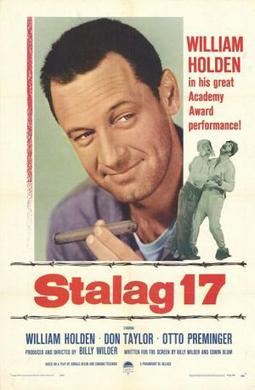
IMDb ??? Review: Stalag 17 (1952)

Source: Wikipedia
Important historical distinction: Nazi POW camps were nothing like concentration camps. POW camps were more like shitty low-budget Jesus Camp with machine guns, and concentration camps were concentration camps.

Instead of dying horribly, captured American soldiers bum around, try to escape, then die horribly for trying to escape.

Prisoners fritter away the hours with games like horseshoes, chess, and smuggling contraband. Cigarettes hold strong as currency. Behind closed doors, men indulge in potato skin liquor, literal rat races, and Russian women prisoners within telescope range.

The cast represents the typical motley crew. Cynics, clowns, hotheads, horndogs, psychos, snitches. That’s right–after enough shenanigans implode, the guys conclude there’s a snitch in their barracks. And, spoiler alert, they’re right.

Like most movies about grown men forced into intimacy, this film showcases human brotherhood under duress, and just how quickly it breaks down. (Very.)

The narrator, a stammering nobody, does more telling than showing, or doing anything useful at all. If not to advance the plot, he exists to contrast the interesting characters that do interesting things, which is just about everyone else.

It's funny, but not sidesplitting funny, unless you’re getting knifed in the ribs. Because beneath the veneer of silliness lies deadly seriousness, like the rainbow film of grease over dishwater-grade “potato soup.” But despite the grim tone, the ending dispatches sweet, sweet justice. It’s like Hogan’s Heroes with balls.

Recommended for smug pragmatists, Jesus camp refugees, and staunch authoritarians who cannot comprehend that tighter regulations (MORE MACHINE GUNS) lead to rebellion, not obedience.

120 minutes.

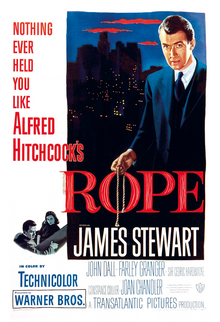
IMDb ??? Review: Rope (1948)

Source: Wikipedia
Nothing kills the mood of a murder scene like a party. Especially inviting the unsuspecting friends and family of the very recently deceased.

Unless you’re the protagonists of Alfred Hitchcock’s Rope.

Two Ivy League college students kill a peer on a whim and tackle the consequences with aplomb. One, a worrywart with a conscience; the other, a smarmy devil in a nice suit. Harvard’s Hitler waxes eloquent about murder as an art form, a right the intellectually superior supposedly wield over inferiors. His actions, such as sabotaging his cushy life out of sheer hubris, call into question the intelligence he assigns himself.

Through what seems like one gruelingly long take, Hitchcock, the master of suspense, casts his spell. And nothing spells “old movie” like grainy Technicolor, credits at the beginning, and a parade of cigs and hats and booze.

Most of the movie is dull and/or uncomfortable conversation. Old ladies natter about food, astrology, movie stars. The Ivy League stranglers alternate between insisting there’s nothing wrong and insinuating, “HE’S DEAD AND WE KILLED HIM AND I’M SMARTER THAN ALL OF YOU DUMBASSES AHAHAHAHAHA.”

So much potential. Add brisk editing and a slide-whistle soundtrack, and it’s a forties-era cringe comedy; kill the music and substitute a droning voiceover, and you have a systematic documentary guide to failing at crime and throwing shitty parties.

Overall, I'd say it examines the difference between preaching a philosophy and living it out. Like the difference between tenured poli-sci profs who shill Marxism in the classroom and their comrades who gnaw off their own frostbitten fingers in Siberian gulags.

Recommended for sadistic party animals, anti-social Darwinists, and fulfillers of both categories, such as Alfred Hitchcock.

80 minutes.

IMDb ??? Review: Before Sunset (2007)

Source: Wikipedia
Eighty minutes of conversation.

Two people talk for well over an hour. And I adored every minute.

Whoa.

A writer at a book signing in Paris reunites with the woman who inspired his runaway bestseller. Before he has to catch his plane, they catch up, walking and talking around picturesque Paris as the sun slowly sets, along with any likelihood of them ever meeting again.

The dialogue sparkles in shameless realness–sometimes choppy and awkward, then smooth and relaxed and funny again. It’s a lot of fun to watch. The topic wanders as much as the characters do: from bookshop to cafĂ© to alley to ferry to taxi, from books to music to philanthropy to sex. (Yes, as grown-ups, they’re going to discuss the dirty deed. Frankly.)

These two can talk to each other about anything, and they do. I envy that feeling, even in my stable monogamous relationship with my word processor -- we’re currently floundering in the post-honeymoon phase, no longer able to impress each other but still attempting to regardless of results.

Back to the movie.

It’s an anti-romantic nuke. Despite the romantic subject matter (reunion of separated lovers), in the most romantic city in the world (Paris). It smacks of cold, hard reality, like a suicide jumper kissing the asphalt at terminal velocity.

Spoiler alert: the ending’s implications support my aforementioned suspicions about Parisian culture. (Infidelity. Everywhere.)

Recommended for hopeful romantics looking for love, hopeless romantics who found love and want out, and socially crippled rom-com characters who direly need lessons in the most rudimentary interpersonal communication.

80 minutes.

Monday, April 20, 2015

IMDb ??? Review: Underground (1995)

Source: Wikipedia
What. The. Hell. Was. That.

In this Serbian film (not THAT one), two exquisitely mustached sociopaths run amok in Belgrade, Yugoslavia, during the opening credits and over the whole three hour runtime. They save and kiss and punch each other, squabble over a woman, and spark bloody revolutions. (According to Ten Seconds of Googling, the director wanted FIVE hours.)

This manic tragicomedy spans generations, decades, wars. Or what the poor bastards who spend decades in a bomb cellar think is one war.

A.D. 1941. Some battered citizens of Belgrade retreat underground to make weapons to fight the Nazis. But the war ends. The brilliant bastard running the operation convinces his people that World War II still rages. While his comrades toil, he sells their guns and the movie rights to his exaggerated memoirs. Underground, children grow up. People marry. Then some wander outside…

It’s a strange ride. A surreal emotional carousel: constant motion, fluctuation between high drama and low comedy, and a persistent sensation of nausea. There’s slapstick, pointless death, and spontaneous brass ensembles. Pratfalls, mistaken identity, and electroshock torture. Weddings, funerals, movies, and a chimp in a tank. A grisly finale with genocide, complex politics, and unconvincing old-age makeup.

If there’s any message, it’s too obscure or too obvious for me.

Overall, it’s a bizarre, rambling parable about exploitation, enforced ignorance, and facial hair. To quote one mustached sociopath, “We’re all crazy. We just haven’t been diagnosed yet.”

Recommended for psychedelically inclined historians, mole people, and clinically depressed former Yugoslavians.

167 minutes.

IMDb ??? Review: Trois Couleurs: Rouge (1994)

Surprise, monolinguals! The title’s in French because the whole movie’s in French, the language English can thank for its longer, stuffier words. Our joie de vivre, esprit de corps, raison d’ĂȘtre, without which we’d succumb to ennui and l’appel du vide.

A French model rescues an injured German shepherd (dog, not sheep-herder) and returns it to the grouchy old owner. This man’s sole pleasure in retirement, apart from nursing loneliness and neglecting pets, is to snoop on saucy local phone calls via Ham radio.

Through this plot development, we discover the unlikely ties that bind strangers who live on the same street. Also, the entire population of France is a seething cauldron of hot, sweaty infidelity.

How to describe this film? The third entry in a trilogy I’ll never finish. A glacier-paced common-place drama tinged with bittersweet realism and Dickensian coincidences. A study of human relationships and distractingly ancient telephones.

Because it’s slow, serious, and represented on the IMDb Top 250, I probably missed boatloads of symbolism. It’s dark, not for objectionable content, but because in some scenes you can’t make out a blasted thing.

One thing: for a movie called Red, there’s remarkably little red. Except lipstick, a thematically significant billboard (i.e., it shows up more than once), and the profound lack of blood geysers.

On that note, the soundtrack is excellent. Instead of Akira’s 80’s-tastic sci-fi techno cheese-mania, Rouge broods to symphonic orchestra and classy classical-esque.

Recommended for dog lovers, Francophiles, and overzealous lovers/law students.

99 minutes.

IMDb ??? Review: Akira (1988)

Source: Wikipedia
Hell yes, anime.

The bottom slot changes position more than an electron running for president, but on 01-01-15, it settled on Akira.

In the late eighties, this gritty imported classic slugged Western audiences square in the gut. It blasted a Japanimation-shaped hole in the chest we’ve been struggling to plug ever since.

Fine, I confess--I’ve seen this one. The anime bug caught me young. In middle school, Naruto on Toonami snagged my feeble pubescent attention span. I hopped aboard the weeaboo wagon waving a rubber kunai and squealing, “Dattebayo!”

Let us never speak of this again.

Like many popular Asian cartoons, Naruto suffers from tedious monologues, highly stylized action sequences, and clunky dubbing. Akira, however, offers…tedious monologues, highly stylized action sequences, and clunky dubbing. (Don’t match the voices to the flapping lips; you’ll sprain your brain.)

At least the 2001 Pioneer English dub’s roster stars Johnny Yong Bosch (Vash the Stampede, Ichigo Kurosaki, Lelouch Lamperouge, everyone who's NOT Stephen Blum) and his immortal name-yelling...

"TETSUO!”

KANEDA!

“TETSUOOOOOOOOOOO!”

KANEDAAAAAAAAAAAAAAAAAA!

“TETSUOOOOOOOOOOOOOOOOOOOOOO!”

Also like Naruto, the hero and anti-hero spawn a bromance that could engulf planets.

Sound quality aside, the animation is BEAUTIFUL. Every frame of lovingly crafted ultraviolence screams genius, obsessive attention to detail, and probably agonizing wrist cramps.

Call it the rebellious step-cousin of Studio Ghibli (repeat offenders on the 250), replete with motorcycle chases, brutal violence, urban destruction, drug-induced progeria, and toon boobs. (Objectively superior? Perhaps.)

Recommended for mature audiences who can appreciate spectacular animation, blood geysers, and awesomely awful dubbing.

121 minutes.